
The Ryuha - 学校
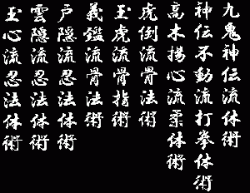

The Bujinkan organization incorporates the teachings of the martial arts lineages (ryūha) that Masaaki Hatsumi learned from Takamatsu Toshitsugu under the banner of Bujinkan Budo Taijutsu.
These are:
-
Togakure-ryū Ninpō Taijutsu (戸隠流忍法体術)
-
Gyokushin-ryū Ryū Ninpō (玉心流忍法)
-
Kumogakure Ryū Ninpō (雲隠流忍法)
-
Koto Ryū Koppō jutsu (虎倒流骨法術)
-
Gyokko-ryū Kosshi jutsu (玉虎流骨指術)
-
Kuki Shinden Happō Bikenjutsu (九鬼神伝流八法秘剣術)
-
Shinden Fudo Ryū Dakentai jutsu (神伝不動流打拳体術)
-
Takagi Yoshin Ryū Jūtai jutsu (高木揚心流柔体術)
-
Gikan Ryū Koppō jutsu (義鑑流骨法術)
At around the time of Hatsumi's 88th birthday (Beiju: ja:米寿) on 2 December 2019, he announced his successors for most of the above schools:
-
Togakure-ryū: Tsutsui Takumi
-
Gyokushin-ryū: Kan Jun'ichi
-
Kumogakure-ryū: Furuta Kōji
-
Kotō-ryū: Noguchi Yukio
-
Gyokko-ryū: Ishizuka Tetsuji
-
Kukishin-ryū: Iwata Yoshio
-
Shinden Fudō-ryū: Nagato Toshirō
-
Takagi Yōshin-ryū: Sakasai Norio
-
Gikan-ryū: Sakasai Norio
Bujinkan Budō Taijutsu training does not include participation in competitions or contests, as the school's training aims to develop the ability to protect oneself and others using techniques that focus on disabling an attacker (and/or removing their desire/ability to continue) as quickly and efficiently as possible.
This training is conducted in a manner in which there are predefined "attackers" (tori) and "receivers" (uke) similar to drills in judo (gokyo) or traditional Japanese martial arts.
However, the Bujinkan differs from many traditional martial arts in that the training progresses through the following stages:
-
Predefined sets of movements (kata) and physical conditioning
-
Variations to the fixed drills (henka), responding to changes in the attacker's movements or situation
-
Free form training (randori) consisting mostly of spur-of-the-moment, dynamic techniques during which the defender hits, locks, chokes or throws the attacker in a controlled and safe manner
-
More advanced training consists of controlling the attacker's mind using various techniques such as pain compliance and deception
Training is done in a manner that entails little risk of permanent injury.
The Bujinkan does not adhere to any official guideline or set of rules to limit actions or techniques used during training.
The approach used in the Bujinkan includes gaining compliance through pain and utilising potentially damaging techniques in order to survive dangerous situations rather than focusing on winning a competition or evenly matched duel.
As a result, many of the staple responses of a Bujinkan student would be inappropriate in most competitions. It is also important to note that unlike competition martial arts, Bujinkan training does not involve testing techniques (locks, throws, chokes, strikes, etc.) against a fully resisting opponent.
The Bujinkan largely focuses on “taijutsu” (body movement / skills) as well as other skills of ninjutsu (ninpo tactics and strategies) and happo biken jutsu (various modern and traditional weapons) - this is The Bujinkan's branch of Kukishin-ryū
